
June 15, 2026
- Embedded: the business is the program.
- Integrated: the business and the program share people, space or expertise.
- External: the business is separate, and its profits support the mission.
Each can serve a mission well. When I led two family foundations, many of my most useful conversations with nonprofit leaders started here: which of these were they building, and what would it take to do it well? I learned that each model calls for different investments and different ways of measuring progress.
When the business is the program
In an embedded model, delivering the product or service is itself part of the program. The people you serve may pay for it, do the work or both.
Fee-for-service is one familiar version. When someone learns Transcendental Meditation through Maharishi Foundation USA, the instruction delivers the mission, and course fees, supplemented by philanthropy, pay for it. Tuition works the same way at Maharishi International University, where online students are both the customers and the people the mission serves.
We worked with leaders to identify the systems and skills they needed, then funded those improvements: a simpler way to sign up and pay online and, at the university, online course development and faculty training. We released the funding in stages tied to progress and reviewed quarterly, which gave leaders room to build and gave all of us a regular moment to adjust. Maharishi Foundation USA recorded more than 14,000 course bookings in 2024.
Embedded models also raise a question of access, because when participants are the customers, price helps decide who can join. One answer is to change who pays. In New York City, for example, the FDNY Foundation pays for firefighters to learn meditation through the David Lynch Foundation.
When the business and the program share assets
An integrated model uses the same space, staff or expertise to serve both paying customers and the community.
In Washington, Building Bridges Across the River raised the capital for its THEARC campus through charitable contributions. Today it rents its theater and black box to community groups, nonprofits and businesses, offers subsidized rates to the community and gives its resident nonprofits space free of charge. Its 2025 annual report counts more than 20,000 visitors at performances across THEARC Theater, the Black Box and its iCAN Technical Theater Program. The same stage earns revenue and hosts the neighborhood. Because community rates are subsidized, rentals cover part of the cost, and gifts from individuals, companies, foundations and government make up the rest. Donor support also helped sustain its community work during the pandemic, including providing vaccines and groceries to neighbors.
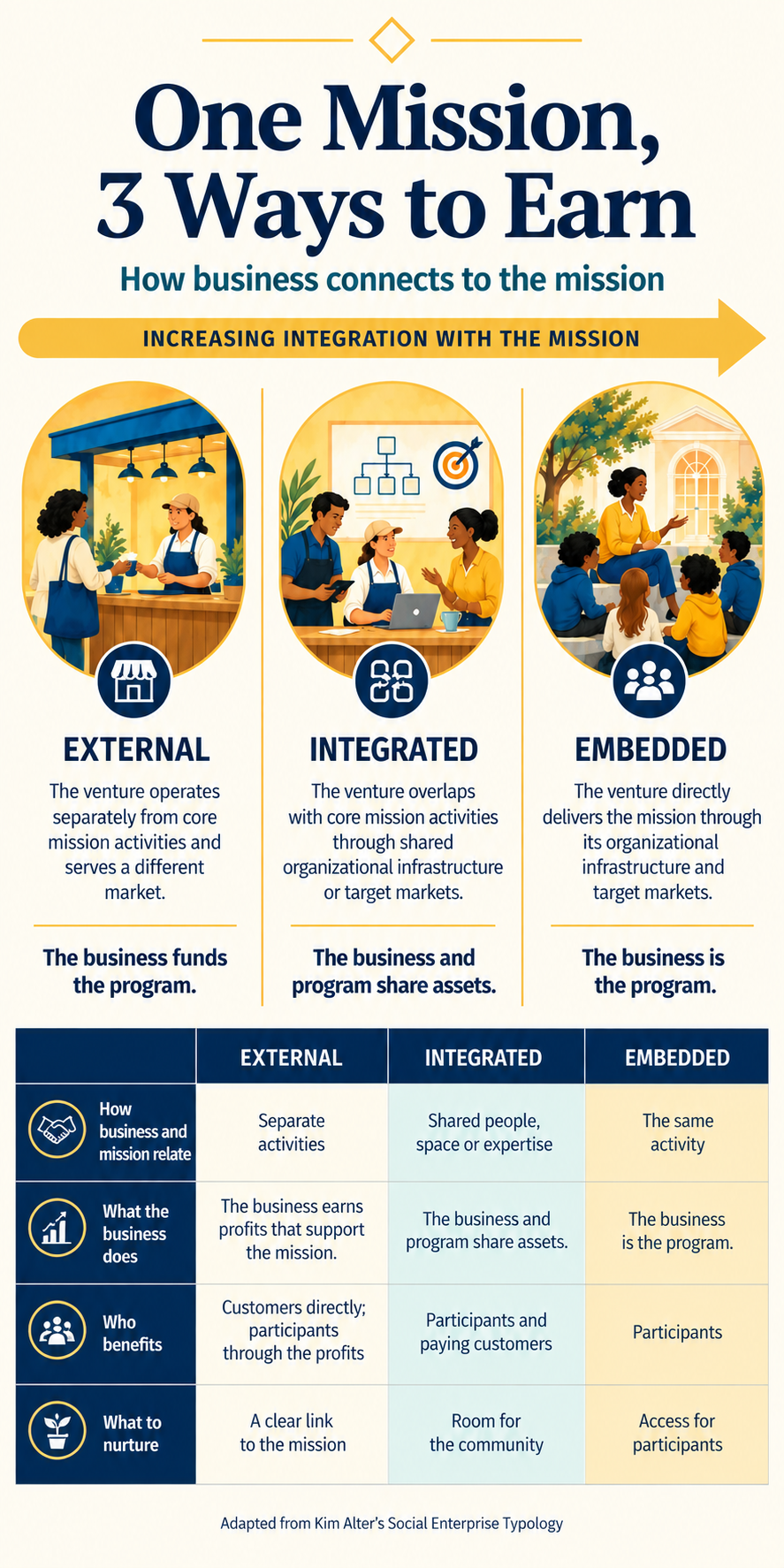
Integrated models depend on two habits. The first is honest cost allocation: when staff, utilities and maintenance are shared, a clear method shows what the business actually contributes. The second is a written access rule that keeps room for the community the asset was built for. Paying customers are welcome, and the rule helps the calendar reflect both purposes.
When the business supports the mission from outside
An external business earns money that the mission then spends: a shop selling general merchandise, a café serving the public or a nonprofit-owned company that sends dividends home. An external business needs to make a reliable profit after covering its costs, without placing the nonprofit’s programs or finances under strain. Purpose, not product, decides the model: a café run to raise funds is external, while a café that trains or employs program participants could be embedded.
In Uganda, directly and through the East Africa Fund, we supported a grain mill at EDAPO, a school serving children orphaned by AIDS. It became the school’s first income-generating activity, and its earnings help cover school operations such as teachers’ salaries.
External models benefit from a leader with business experience, separate books and a clear agreement about how profits reach the program. Structure matters here. In the United States, a regularly conducted business that is not substantially related to an organization’s exempt purpose may generate taxable income, subject to exceptions. A business that grows large may eventually belong in a separate for-profit subsidiary, so involve counsel early.
What every model needs
Full costing. Count staff time, space, systems and the cost of learning, so you can see what the business contributes.
A deliberate access plan. Decide in advance whom you’ll subsidize and how you’ll pay for it.
Patient start-up capital. Philanthropy is well suited to research, pilots and training. A grant, a recoverable grant that may be partly repaid if revenue milestones are reached, or a low-interest program-related investment can each fit different stages.
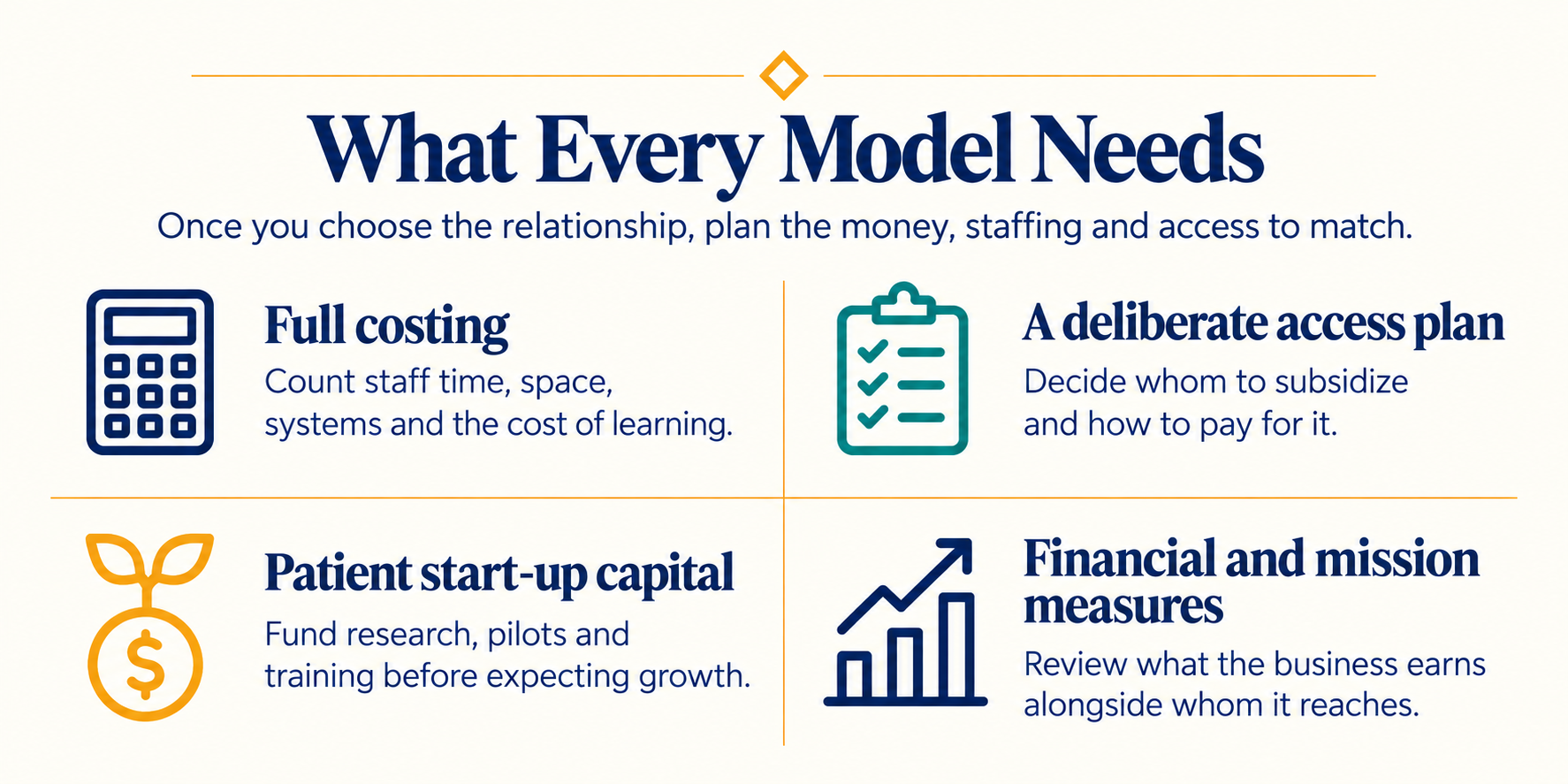
Measures that hold both results together. In our grantmaking, we asked leaders to choose the qualitative and quantitative measures they found most meaningful, then reviewed them together and adjusted. For earned revenue, that meant looking at financial and mission results side by side: enrollment alongside graduation, bookings alongside who was reached.
A deliberate choice
The relationship between business and mission isn’t fixed. An organization might charge for a course, rent its hall on weekends and someday spin off a company. Each choice will still call for judgment and adjustment along the way. Choose the relationship deliberately, then plan the money, staffing and access to match. Know what the business contributes to the mission, and what the mission requires from the business.
Disclosure: Through the Rona and Jeffrey Abramson Foundation and the Eric Schwartz Family Foundation, which I led, we supported the organizations described here, including EDAPO partly through the East Africa Fund.
Sources
- Kim Alter, Social Enterprise Typology, Virtue Ventures, revised 2007.
- IRS, Unrelated business income tax.
- Foundation Source, “Multiply the Impact of Year-End Giving by Leveraging Recoverable Grants”.
- Building Bridges Across the River, THEARC venues.
- Building Bridges Across the River, 2025 Annual Report.
- Inside Philanthropy, “What’s Next for the David Lynch Foundation? A Q&A with CEO Bob Roth”.