
When I first became involved with a small private university, its student population was shrinking.
The average student was in their mid-thirties. The university had a distinctive educational philosophy and loyal supporters, but it was struggling to attract a new generation of students.
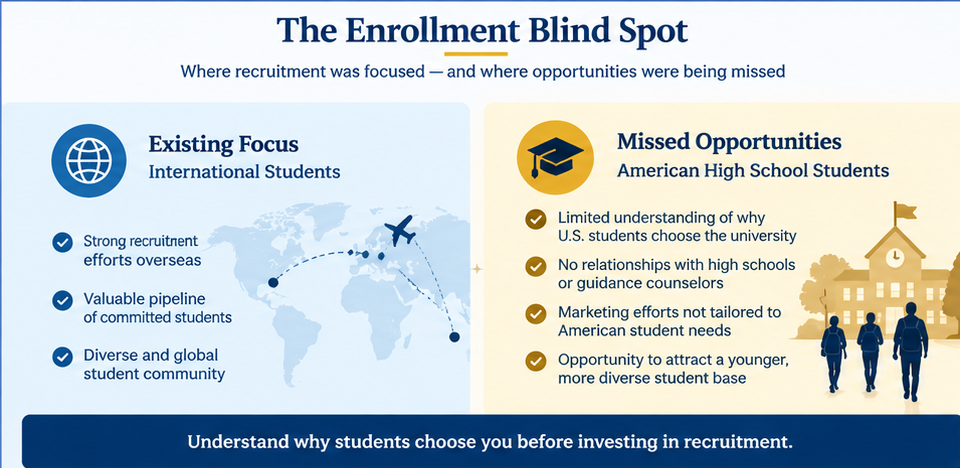
Its marketing efforts focused heavily on international recruitment. There was little understanding of why American students might choose the university, what they were looking for or how they made enrollment decisions.
The university also lacked established relationships with high schools that would allow guidance counselors to introduce its programs to prospective students.
Yet one area was attracting growing interest: digital education.
Our foundation had supported the university’s strategic initiatives, but the challenge was becoming increasingly clear. Providing more money wouldn’t address the underlying problems.
We needed to understand why enrollment was declining, how the university was using its resources and what it would take to build an institution that could adapt.
And we needed to do that without losing the educational philosophy that made the university distinctive.
An endowment isn’t an operating strategy
University endowments can provide a measure of financial stability. They support scholarships, faculty, research and institutional operations.
But an endowment cannot replace effective management.
In February 2022, the NACUBO–TIAA Study of Endowments reported unusually strong investment performance for fiscal year 2021. At the same time, endowment managers were concerned about inflation, rising expenses and the need to preserve long-term purchasing power.
The average annual spending rate was 4.54%, while more than half of participating endowments had increased their support for institutional operating budgets.
That distinction matters.
An endowment’s market value doesn’t tell a board how much unrestricted cash is available. Donor restrictions, spending policies and investment liquidity all affect what can be used.
An institution may have substantial investments and still struggle to meet payroll, maintain buildings or finance its next academic term.
For smaller universities, the margin for error can be particularly narrow.
A decline in enrollment reduces tuition revenue, but many costs remain. Faculty, facilities, technology and student services cannot always be reduced at the same pace.
The question isn’t only how to protect the endowment.
It’s whether the university has an operating model that can sustain the mission the endowment was created to support.

We weren’t reaching the students we needed
The first challenge was understanding enrollment.
The university had relied heavily on international recruitment, but prospective students were increasingly experiencing difficulties obtaining U.S. student visas. Even when students were accepted, there was uncertainty about whether they would receive their visas in time to enroll.
That created significant financial challenges. The university could not reliably plan faculty appointments, housing or student services around students whose arrival remained uncertain.
Meanwhile, its existing student population skewed older. Adult learners were an important part of the university’s community, but we weren’t doing enough to attract younger American students.
We needed to understand why those students might choose a small private university. What programs interested them? What kind of campus experience did they expect? How did they make enrollment decisions?
And how would they even discover the university?
There were no established relationships with high schools through which guidance counselors could regularly introduce the institution to prospective students.
We also needed better information about recruitment. Which programs generated inquiries? Where were applications being lost? Why were prospective students choosing other universities?
This wasn’t simply a marketing problem.
Recruitment, admissions, academic programs, housing and student services needed to work together. We couldn’t attract a younger student population without understanding what it would take to support them.
National data reinforced the urgency. The National Student Clearinghouse’s spring 2022 report found that postsecondary enrollment had declined 7.4% over two years, representing nearly 1.3 million fewer students.
We needed to diversify enrollment, reduce our dependence on international recruitment and understand what American students were looking for before investing more money in attracting them.
One area was growing. Were we prepared to change?
While much of the university was experiencing enrollment challenges, demand for digital education was increasing.
That presented an opportunity, but it also raised a question about how the university was teaching.
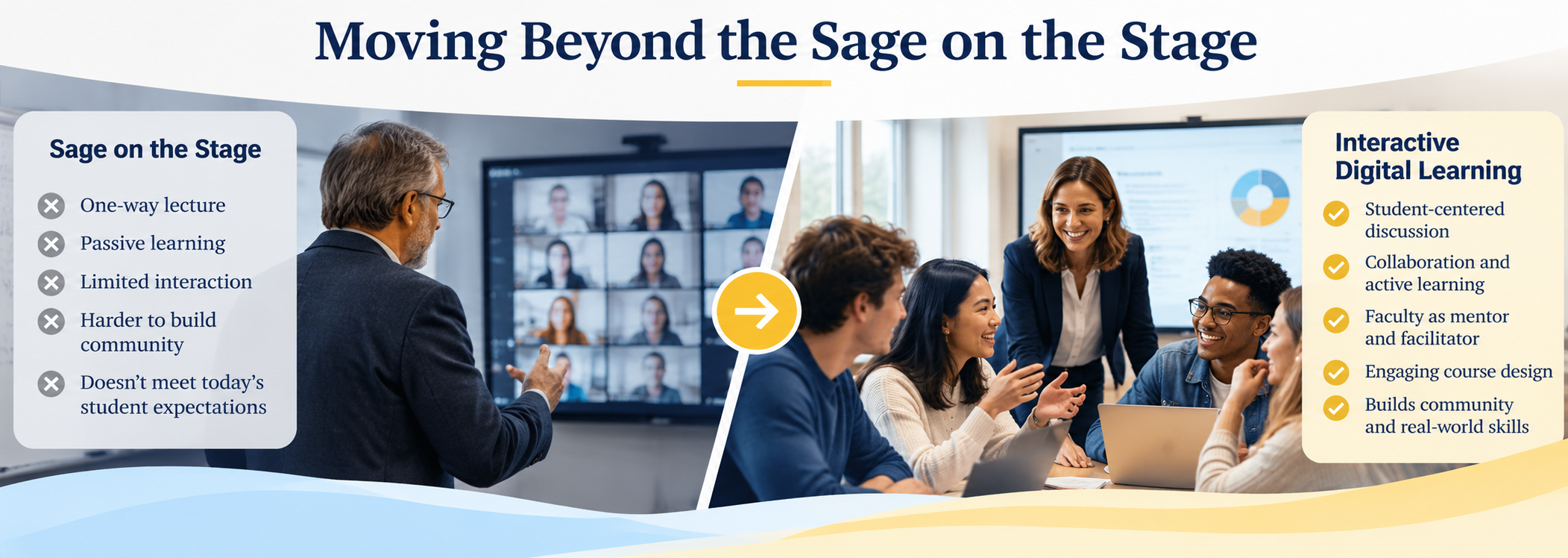
During the pandemic, many professors had become comfortable appearing on Zoom. But delivering a lecture through a screen wasn’t the same as designing an effective digital learning experience.
The familiar model of the professor as the sage on the stage wasn’t necessarily meeting the needs of students studying remotely.
We needed to think differently about engagement, course design, technology and the relationship between students and faculty.
Digital transformation wasn’t going to happen simply because we purchased software or installed cameras.
It required changes in how faculty taught, how students learned and how the university organized itself.
That was consistent with the EDUCAUSE 2022 Higher Education Trend Watch, which emphasized faculty development, curriculum redesign and changes in institutional culture alongside investments in technology.
The challenge was finding a way to introduce those changes that faculty and administrators would understand and embrace.
We went to Harvard….. and stepped away from daily operations
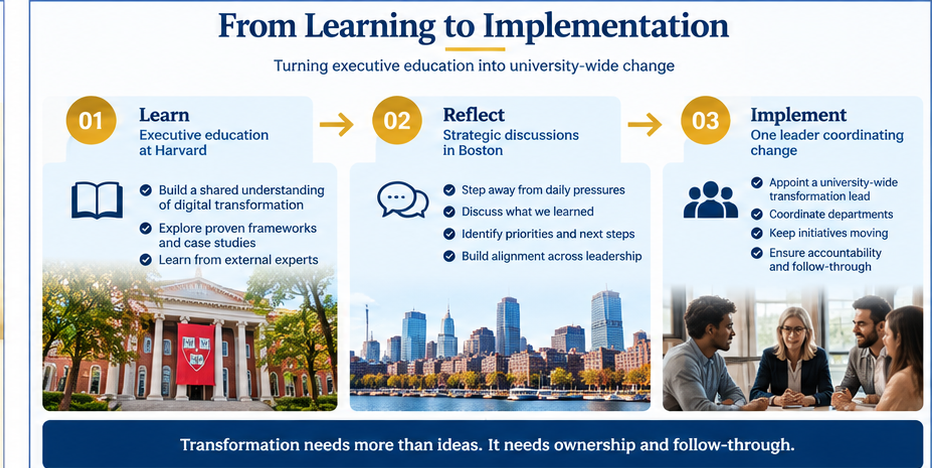
I arranged for a university executive to attend a Harvard executive education course focused on digital transformation.
I participated as well.
I wanted us to have a common understanding of what transformation required, including the leadership decisions, organizational structures and changes in teaching practice that needed to accompany technology.
But the classroom was only part of the value.
We met before and after the course in Boston, away from the university’s daily pressures, to discuss what we were learning and what it might mean for the institution.
That distance mattered.
At the university, conversations were often dominated by immediate operating needs. In Boston, we could focus on the bigger questions.
What did the university want to become? Which assumptions about students and teaching were no longer valid? What would digital education require from faculty? How should recruitment, academic programs, technology and student services work together? What ideas were we getting from course, the cases and our peers?
We also discussed what needed to change in the way projects were managed.
We couldn’t rely on individual departments pursuing separate improvements without a common plan.
Following those discussions, we elevated an individual to lead the transformation across the university.
That gave the work a designated leader responsible for coordinating departments, identifying dependencies, keeping initiatives moving and ensuring that decisions were implemented.
A course can introduce new ideas. Someone still has to be responsible for turning those ideas into institutional change.
Listen to each division before deciding what to fund
Another important part of our approach was establishing regular meetings with individual university divisions.
We aimed to meet with each division once a week.
I wanted to hear directly from academic leaders, administrators and staff about their operating needs, enrollment challenges and priorities.
The conversations weren’t always easy.
We asked why some programs were losing students. We discussed whether staffing levels matched enrollment, whether courses could be redesigned and whether administrative processes were creating unnecessary expenses or delays.
We also asked what each department wanted to accomplish.
What was working? What wasn’t? Which activities were essential to the mission? Where was the institution spending money without achieving the expected results?
And when a division requested funding, we asked what that investment would actually change.
Sometimes the answer was faculty recruitment. Sometimes it was technology, marketing or curriculum development. In other cases, better communication between departments was needed before additional money would help.
I wanted the university to understand its costs, but I also wanted us to understand the reasons behind those costs.
A program that appeared expensive might be essential to the institution’s identity. Another might seem financially attractive but require more staffing and infrastructure than anticipated.
We needed to consider both.
The goal wasn’t to arrive with a list of cuts.
It was to understand the institution well enough to distinguish expenses that should be reduced, investments that deserved support and practices that needed to change.

Learn the institution’s language
The university had a distinctive philosophy, including its own understanding of organizational change.
I had experience with conventional change-management methods, including ADKAR. But introducing another framework without understanding the university’s approach would have created unnecessary resistance.
Instead, I looked for connections between the institution’s principles and the practical requirements of organizational management.
Its approach to change emphasized stability, adaptability, integration, removing obstacles and growth.
Those ideas could be translated into decisions the university needed to make.
Stability meant understanding which expenses had to be covered reliably.
Adaptability meant responding to changes in enrollment and student expectations.
Integration meant ensuring that academic departments, recruitment, admissions and financial management were working together.
Removing obstacles meant identifying the procedures, assumptions or resource constraints preventing progress.
Growth meant investing where the university could demonstrate demand and had the capacity to deliver.
The terminology wasn’t a superficial consideration.
It helped us communicate without asking faculty and administrators to abandon the philosophy they believed in.
Outside expertise can be valuable, but it needs to be translated into the institution’s own environment.
The purpose of change management isn’t to replace an organization’s culture. It’s to help people use their knowledge and values to make better decisions.
Build trust in both directions
As a funder, asking difficult questions about costs and performance can create tension.
A university’s leadership may worry that acknowledging a problem will put future funding at risk. Yet withholding that information carries risks of its own, particularly when difficult decisions are postponed.
Faculty may view outside recommendations as a threat to their independence or the institution’s mission. That concern can be especially strong when they have experienced donor fatigue, well-meaning supporters offering unsolicited advice without providing the resources needed to implement their recommendations.
And funders can make their own mistakes by assuming that familiar business practices will translate easily into academic settings.
We needed trust in both directions.
I wanted university leaders to be candid about their challenges, including decisions that hadn’t worked.
I also understood that this institutional culture required patience and sustained support. Meaningful transformation could take four or five years. We couldn’t expect a university facing deep financial challenges to change overnight.
In return, we had to listen carefully, respect academic priorities and remain willing to change our own assumptions.
The weekly meetings helped.
Over time, we gained a better understanding of what each division was experiencing. Staff could explain their challenges and priorities, while we could ask more informed questions about costs, revenue and implementation.
We weren’t making decisions from a distance.
We were working through the issues with the people responsible for carrying them out.

Growth creates its own cash-flow problems
The university’s financial challenges reinforced an important distinction between revenue, profitability and liquidity.
Attracting more students was only part of the equation. The university also needed to be prepared to welcome them.
A successful recruitment effort might require hiring additional faculty before tuition revenue arrived. Student residences needed improvements, and the needs of younger students were different from those of the university’s predominantly older student population.
For example, younger students might expect a more traditional campus experience, with opportunities for social interaction, academic guidance and extracurricular activities. Older students might place greater value on flexible schedules, independent living arrangements and services that accommodated work or family responsibilities.
Even small details mattered. Housing arrangements, dining hours, transportation, orientation and the availability of student support could influence whether a prospective student enrolled, felt comfortable and ultimately stayed.
A recruitment strategy could succeed in bringing students to campus but fail to retain them if the university hadn’t considered the experience it was promising.
Those details also carried financial implications. Improving residences, expanding student services and adapting campus facilities required investment, often before the university knew whether higher enrollment would justify the additional costs.
A new academic program presented similar challenges. Marketing, curriculum development, technology and administrative support might all be needed before the first student enrolled.
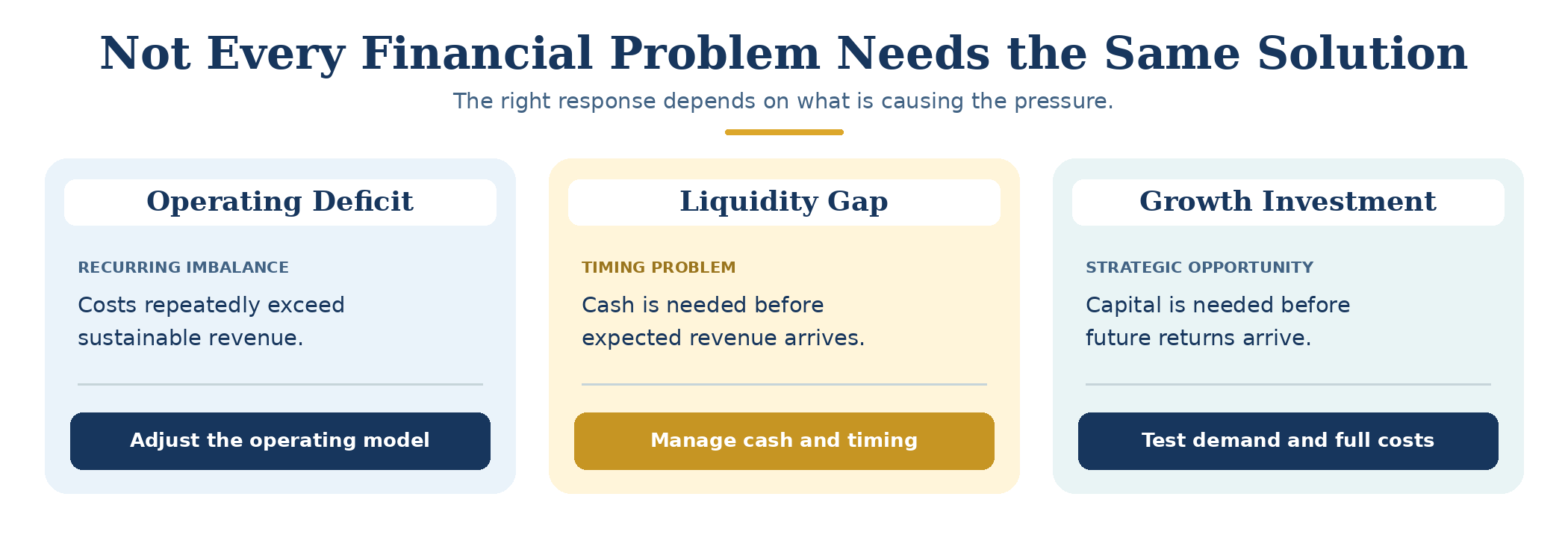
That created three different financial questions.
Was the university running a recurring operating deficit?
Was it experiencing a temporary cash shortage because expenses came before revenue?
Or was it considering an investment that could generate future growth?
Those situations shouldn’t be treated as interchangeable.
An operating deficit requires structural decisions about revenue and costs.
A temporary cash-flow problem may justify short-term financing if the expected revenue is credible and the institution has a realistic repayment plan.
A growth investment requires an assessment of market demand, implementation capacity, expected revenue and the full cost of delivering the program.
During our work, we considered several funding arrangements in which temporary advances could replenish a designated institutional fund when revenue arrived.
That approach could preserve financial flexibility, but it also required discipline.
We needed to understand not only how many additional students the university hoped to attract, but also what it would cost to accommodate them, support their success and retain them through graduation.
The institution also needed to know when money would be required, which obligations were coming due and how much unrestricted cash would actually be available.
For a university with limited reserves, the difference between attracting students and successfully serving them could determine whether growth strengthened its finances or created another cash-flow crisis.
Invest where students are choosing you
The strongest argument for strategic investment came from understanding where students were showing genuine interest.
We could see the potential of digital education, but expanding that opportunity required more than adding online courses.
Faculty had to be prepared to teach differently. Academic programs needed to be designed for the intended students. Recruitment and admissions needed to reach the right audiences. Technology had to support the experience.
And the university needed someone coordinating those efforts across departments.
This was also why I wanted more attention given to American students and relationships with high schools.
A sustainable enrollment strategy couldn’t depend too heavily on a narrow recruitment channel.
It needed to understand different student groups, their motivations and the educational experience each expected.
The same was true of academic programs.
Not every department could expand at once. Some opportunities would need to wait. Others might warrant immediate investment because the demand was clear and the university could respond effectively.
But those decisions needed evidence, not simply enthusiasm.

Protect the institution, not just its endowment
The university experience reinforced something I believe every university board should consider.
An endowment can provide a financial cushion, but it cannot substitute for understanding students, managing operating costs or adapting to changes in higher education.
A university must know who its students are, why they choose to enroll and what it costs to educate them.
Its leadership needs reliable financial information, a clear picture of liquidity and the willingness to examine programs that are no longer attracting sufficient demand.
It also needs to invest in the people responsible for making change happen.
Taking a university executive to Harvard, stepping away from daily operations to discuss what we’d learned, establishing regular meetings with each division and appointing someone to coordinate transformation were all part of that work.
None was simply a technology investment.
They were investments in the institution’s ability to think, decide and act differently.
And they required trust.
There were difficult questions, competing priorities and decisions that couldn’t be resolved immediately. But that was precisely why the work mattered.
An endowment can give a university time to respond to a crisis. Whether it emerges stronger depends on how effectively its leadership uses that time.
Sources
- National Student Clearinghouse Research Center, Current Term Enrollment Estimates: Spring 2022 (2022). National enrollment declines and shifting student participation.
- NACUBO–TIAA, 2021 Study of Endowments (February 2022). Investment returns, spending rates and institutional support.
- EDUCAUSE, 2022 Higher Education Trend Watch (2022). Faculty development, digital learning and institutional transformation.
- EDUCAUSE Review, Digital Transformation in Higher Education: 7 Areas for Enhancing Digital Learning(September 2022). Digital course design and student engagement.