

October 14, 2026
GivingTuesday is seven weeks out. Here’s what still matters.
GivingTuesday falls on December 1 this year. That leaves about seven weeks.
If your team started planning in June, you’re now in the activation stretch: scripts going to the board, copy getting proofed, emails loading into the platform. If you haven’t started, you can still run a good campaign. You just have to be picky about where the hours go, because there aren’t enough of them to do everything on the checklist.
Here’s how I’d spend them.
Lock in the match this week
The best window for securing a matching gift is six to eight weeks before GivingTuesday. In mid-October you’re standing at the back edge of it.
Pick two to four donors who could plausibly fund a match and call them. Don’t email a group of them at once. Frame the request as a leadership gift that multiplies what the rest of your community gives.
When someone says yes, get it in writing: the amount, the ratio (1:1, 2:1), the deadline and any conditions. You’ll be repeating those details in every email and post, so they need to be exact.
If nobody commits by early November, switch to a challenge gift. Something like: if 50 new donors give by midnight, a supporter will add $2,500. It’s easier to say yes to, and it gives you a donor-count goal that’s fun to report on all day.

Choose one story and stop looking
Your theme should fit in one sentence and answer the question a donor is silently asking: what will my gift make possible?
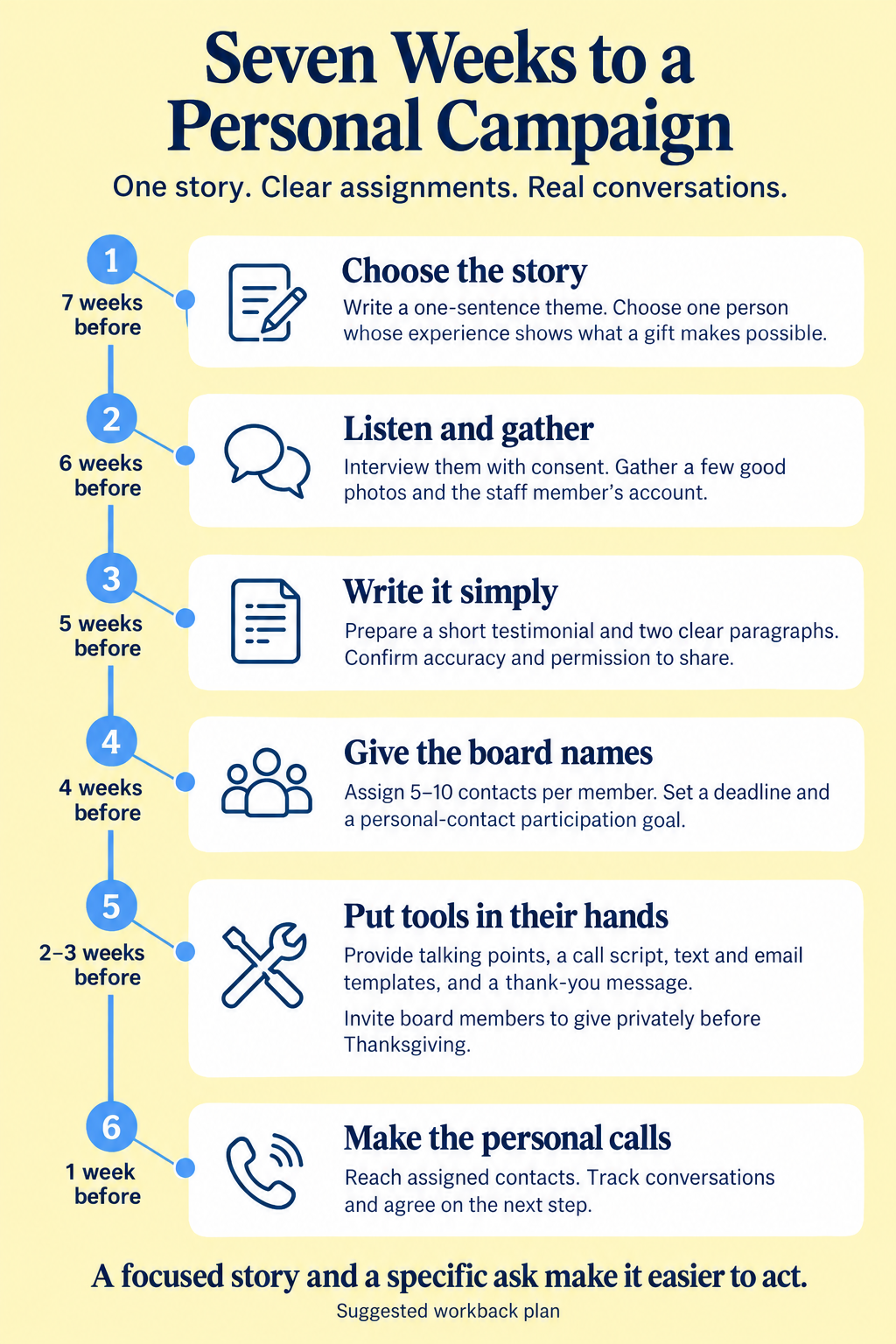
Then find one person whose experience proves it. A single family, a single student, a single afternoon when something changed. “We served 400 families” is a statistic. Six months in one family’s life is a story, and people remember it.
Seven weeks is enough time to interview someone and write it up. It probably isn’t enough to produce a polished video from scratch. A written testimonial, a few good photos and two paragraphs from the staff member who was there will carry the campaign fine.
Give the board something specific to do
Board members are your most credible voices, and most of them will help if the ask is small and concrete. “Please promote GivingTuesday” gets nothing. “Call these seven people the week before” gets calls.
Set a participation goal as the percentage of board members who make at least one personal contact. Assign each person five to ten names. Then hand them the tools so they don’t

have to write anything themselves:
- three to five talking points
- a 30-second phone script
- a short text message and a personal email they can adapt
- a thank-you message for anyone who gives
One more thing to check now. Board members who have already given make better advocates. If your board isn’t at 100% giving, a quiet push before Thanksgiving helps the revenue and the mood in the room.
Write every email before Halloween
Plan on five to seven email touches, starting four to six weeks before the day. For a December 1 campaign, the first one goes out between October 20 and November 3. That’s soon.
GivingTuesday itself needs at least three sends. A morning appeal between 7 and 9 AM. A midday update with real progress toward the goal. An evening message built around the match deadline. Then a thank-you to every donor before midnight. Each one gets its own subject line.
Draft all of them in the next two weeks, proof them once with fresh eyes, and schedule them in your email platform. While you’re at it, open your donation page on your phone and give a test gift. A page that’s annoying on mobile will quietly cost you more than any subject line.
Decide about direct mail now
If you’re including a mail piece, aim for it to land 10 to 14 days before GivingTuesday, which this year means November 17 to 21. Work backward through printing and postage and your copy needs to be final within a couple of weeks.
If that timeline isn’t realistic, drop mail this year. Put those hours into phone calls instead.
Watch for the December 1 collision
Most year-end calendars put the first year-end appeal around December 1. This year, that’s GivingTuesday. Sending both will annoy people and split your message.
Let your GivingTuesday emails serve as the opening of year-end. Hold your next appeal for the following week, keep a second one in mid-December, and save the strongest for December 28 to 30, which is the highest-response stretch of the whole year.
What to skip if you’re behind
If you’re starting late, I’d let go of a campaign hashtag, paid social, a new video and any peer-to-peer program you haven’t already recruited for. None of them will make or break a first-year or catch-up campaign.
Keep the match, the one story, the board calls and the email sequence. And set up campaign codes on every link and channel before anything goes out, so you can tell later who saw the campaign and didn’t give. Those people are your best year-end prospects.
Walk through the day before Thanksgiving
Sometime in the week of November 16, get the team together for 30 minutes and walk through December 1 hour by hour. Who sends each email. Who posts the progress updates. Who watches the donation page for problems. Who sends the board their Monday reminder on November 30.
Thanksgiving week is short and everyone comes back tired. Anything that isn’t decided by then tends not to happen.
Seven weeks is enough. Five will feel tight. If you do one thing tomorrow morning, make it the call to your best match prospect.