

September 7, 2026
Don’t send your best donors the GivingTuesday email
On GivingTuesday your donors’ inboxes fill up with appeals from every organization they’ve ever supported. Open rates are high that day. Response rates get diluted, because your email is one of thirty saying roughly the same thing.
The organizations that do best year after year add something the inbox can’t compete with: a person they know, calling or texting to ask. A personal message converts at a far higher rate than a broadcast email. And the donors who matter most to your budget are exactly the ones who should never get the broadcast at all.
Take major donors out of the campaign
Your major donors and top prospects should have a different GivingTuesday from everyone else. They shouldn’t get the 8 AM appeal with the countdown graphic. They should get a phone call or a sit-down from the executive director or a board member who knows them, one to two weeks ahead of time.

This year GivingTuesday is December 1, so that outreach belongs in the window from about November 16 to November 24. Try to finish before people leave for Thanksgiving. A conversation in that week has room to be a real conversation. On campaign day it would be one more interruption.
Use the campaign as a reason to be in touch. You’re telling them what’s coming, sharing the story at the center of it, and asking what they think. Whether that turns into a gift, and how big, follows from the relationship. A handwritten note works for donors you can’t reach by phone.
The best version of this conversation happens even earlier. Your strongest major donor relationship is also your best candidate to fund the match. Asking someone to provide the gift that doubles everyone else’s is a very different ask from “please give on Tuesday,” and many major donors like being the reason a campaign works.
Don’t forget lapsed donors
People who last gave two or three years ago are some of your best GivingTuesday prospects. They already believed in the mission enough to give once. Often nobody followed up.
A short personal note from someone who remembers them (“we haven’t talked since the spring event in 2024, and I wanted you to hear about this before Tuesday”) will usually outperform any general appeal sent to the same group. You won’t be able to do this for every lapsed donor. Pick the ones with the strongest past connection and divide them up.
Make it easy for the board to say “yes”
Most board members are willing to help, embrace those that are willing. What stops them is a vague ask and a blank page.
Give each board member a specific list of five to ten people and a date to reach them by. Not a request to “share the campaign on social media.” Names. Track it on a simple sheet with columns for the prospect, who owns the relationship, likely gift range, planned action and status, and check in on it at each meeting between now and December.
Then do the writing for them. A 30-second call script might be as simple as:
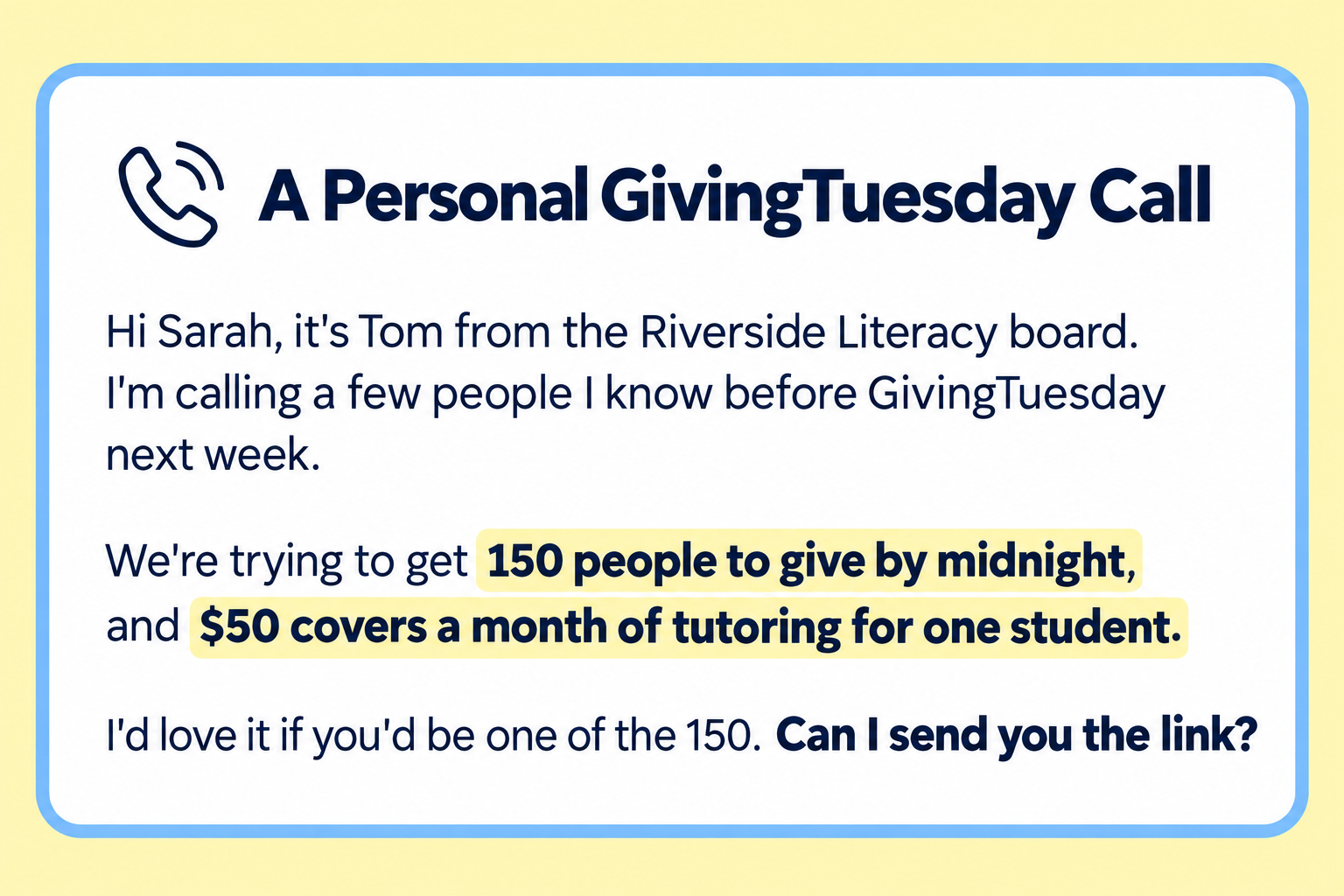
Alongside the script, give them a text template, a personal email they can adapt, a few talking points and a thank-you message for anyone who gives. Set the board’s goal as the share of members who make at least one personal contact, and report progress toward it.
If some board members haven’t given yet themselves, ask them first, privately, before Thanksgiving. People who’ve already given make the call with more conviction, and “I just gave, would you join me?” is a hard line to beat.
Keep the board in the loop on the day
Send board members a reminder on Monday, November 30, with their list, the script and a note on how updates will reach them. On GivingTuesday, give them real-time progress at least at midday and in the evening. “We’re at 72% with six hours left” is something they can forward to a friend in five seconds, and it’s a much better text than “remember to give today.”
After the campaign, the same people make thank-you calls to the donors they reached. Donors who were asked personally should be thanked personally.
Count the conversations
If you track only revenue, personal outreach looks expensive. It’s slow and it doesn’t scale.
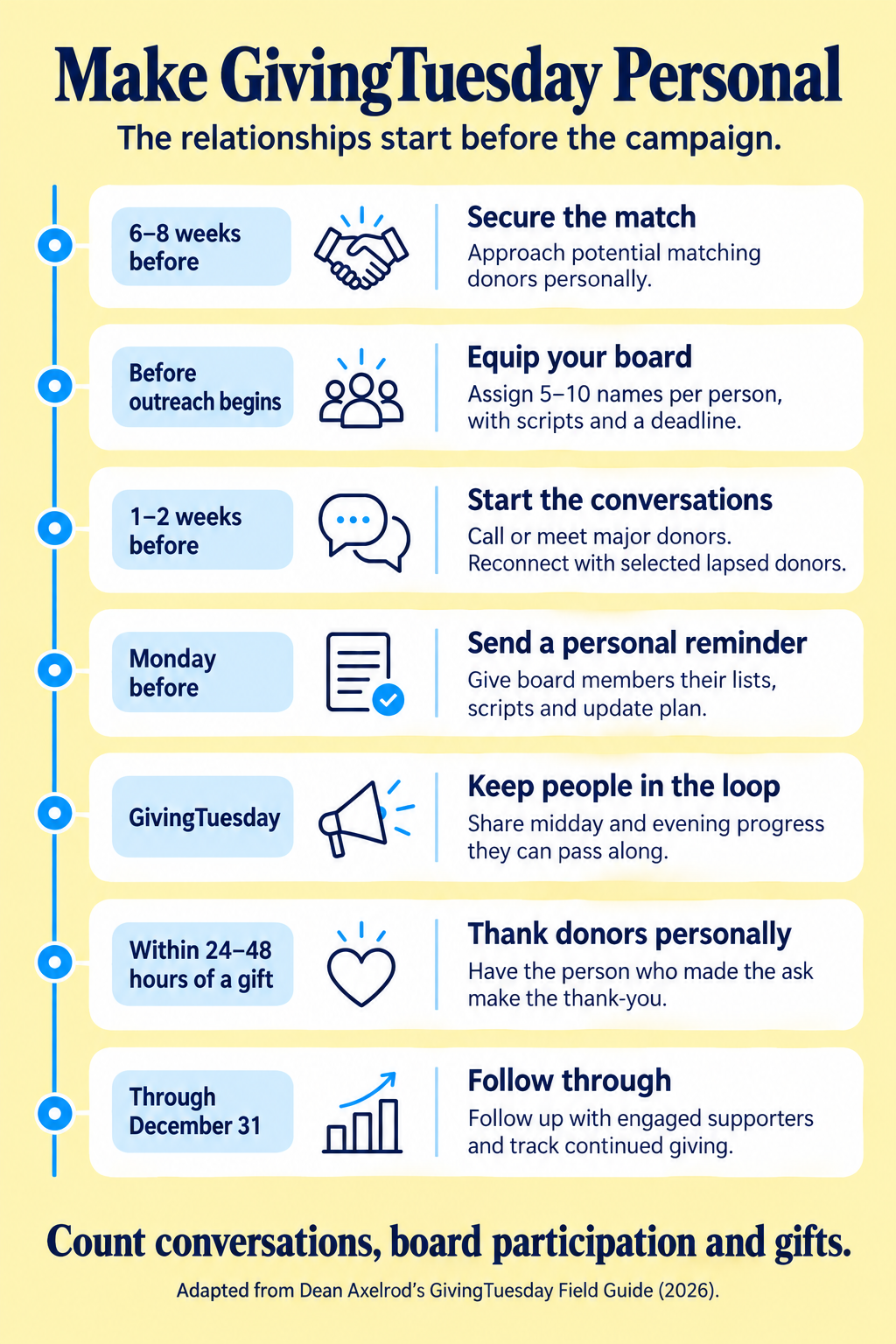
Track the number of personal contacts made, the board participation rate and the gift rate among people who were called versus people who were only emailed. That comparison usually settles the argument about where to put staff time next year.
Email still has a job on GivingTuesday. It’s how you reach most of your list. But your best donors and your best advocates deserve more than a place in the queue. Start making the call list this week.