

April 2, 2026
I spent a lot of time watching nonprofits chase grants. Sooner or later, the same question comes up: could earned revenue make us steadier?
It can. But only when you know the promise people will choose you for. What do they get by choosing you? That question gives a revenue idea a purpose beyond bringing in money.
A well-run class, membership, or rental program can broaden your funding and help sustain services people value. If you lead a nonprofit or serve on its board, that is an opportunity worth exploring. You need to understand what people value and what it costs to provide it well.
Think about Transcendental Meditation. In the United States, Maharishi Foundation USA uses course fees to cover teacher compensation and expenses supporting instruction. The course includes personalized teaching and ongoing support. People are paying for an experience they value, and their fees help sustain the organization providing it.
Earned revenue can also work alongside philanthropy. Ticket sales might support a concert series while a donor funds seats for people unable to afford admission. Buyers expect value for their money. Donors expect their gifts to make a difference. Being clear about what each source supports helps you keep both promises.
Urban Institute’s 2025 national survey found that earned income accounted for an average of 18% of 2024 revenue among the nonprofits covered by the study. That tells us about their funding mix. It does not tell us whether your audience will pay for your idea. You have to discover that with the people you hope to serve.
Imagine an arts organization considering an evening series for young adults. The team assumes tickets are too expensive. But conversations with prospective participants reveal another possibility: people hesitate because they would be coming alone. A welcoming host and an opportunity to meet others might matter more than a discount.
Now there is something useful to test. You could try a small event with introductions built into the welcome, then ask what helped people feel comfortable and whether they would return. A modest experiment can teach you more than an elaborate program built around the wrong assumption.
Your current participants are a good place to start. I would also listen to people who considered attending but never booked, and those who stopped coming. Staff and community partners can help you understand what made participation difficult. Board members can open doors to those conversations and challenge assumptions before resources are committed.
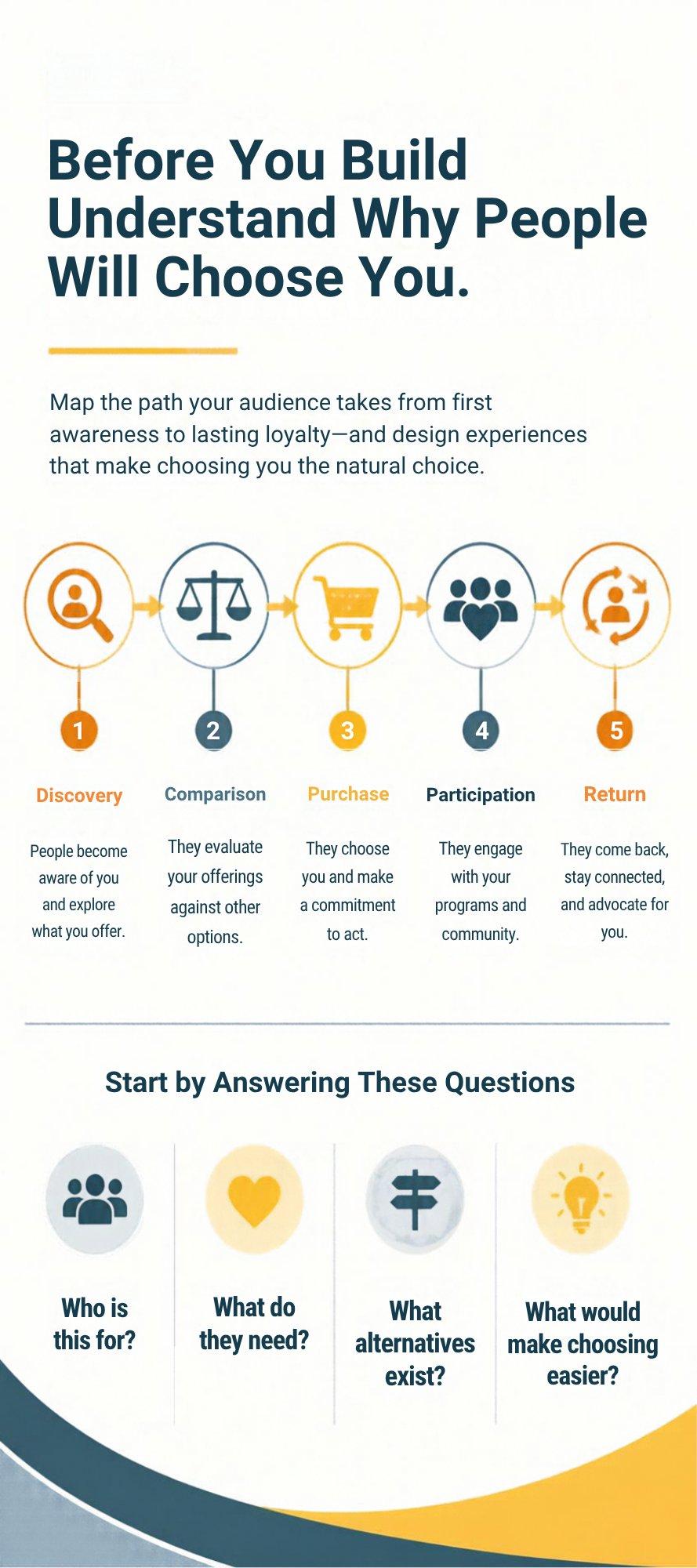
That is how people contribute to a stronger model: they help shape an offer that fits a real need. Their feedback can also show you when to change course. Someone saying they love the idea is encouraging. Someone booking, paying, and returning gives you stronger evidence of demand.
You also need to understand the alternatives. An evening arts program competes with dinner out, streaming, and staying home. Professional training competes with online courses or something an employer already provides. Your mission matters, but people still weigh your offer against other uses of their time and money.
Sometimes your advantage is distinctive expertise. Sometimes it is a convenient schedule or a welcome that makes participation easier. A lower price can help, provided you know how you will sustain quality. Easier booking matters too: people cannot experience a wonderful program if registering becomes a struggle.
The person paying may be different from the person participating. An employer buying training wants to understand its value to the workforce. Employees need an experience worth their time. A donor funding access has another set of expectations. Your offer needs to make sense to each.
Before expanding, I would look at whether enough people choose the offer, what it costs to serve them well, and whom the price leaves out. Those answers become the foundation of the business plan. Early results give your team something to learn from, including the ideas that need to be changed or stopped.
The art is recognizing what people value. The science is finding out whether you can provide it sustainably. If arriving alone is what keeps a young adult away, a cheaper ticket leaves the barrier untouched.
Before investing in the solution, know the promise people will choose you for, and whether you can keep it.
Sources
- Urban Institute. How Government Funding Disruptions Affected Nonprofits in Early 2025. October 2025. Report.
- Institute for Strategy and Competitiveness, Harvard Business School. Strategic Positioning.
- Maharishi Foundation USA. The TM course fee.