

August 13, 2026
Am I a Humanitarian?
I recently met with a client who told me she didn’t think of herself as a humanitarian. She sponsors scholarships for promising students from poor families, year after year. But she doesn’t give in response to disasters in the news. In fact, she’d rather avoid the news altogether. To her, “humanitarian” meant rushing to the latest crisis, and that wasn’t her.
I understood. For years I never thought of myself as one either. That word was for people in field hospitals and refugee camps. Maybe you feel the same way. You give to your church, you drop groceries at the food bank, you check on the neighbor who lives alone. Is that humanitarian?
I think it is, and so do the world’s great faith traditions. Christianity calls believers to serve “the least of these.” Catholic teaching speaks of a preferential option for the poor. Islam makes zakat a pillar of faith. Judaism calls giving tzedakah, from the word for justice. Buddhist traditions emphasize dana, the practice of generosity. None of them asks whether the need came from a war or a hard winter.
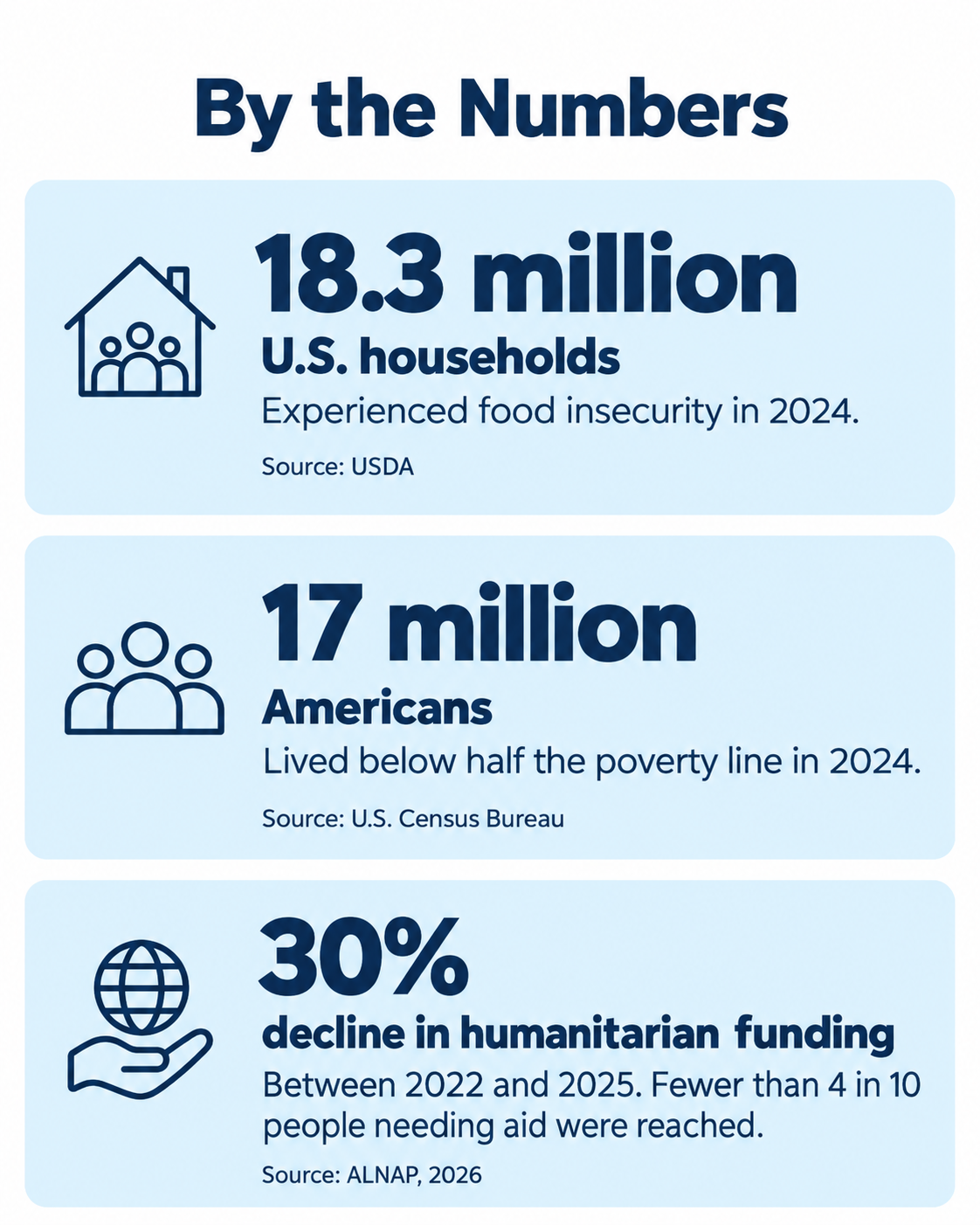
Here’s something most people don’t realize: far fewer of us give overseas than at home. In a March 2025 AP-NORC poll, only 15% of Americans said their household had given to an international aid organization in the past year, compared with 40% who gave to groups helping people in the U.S. with food, shelter or other basic needs. In dollars, about 5% of the $617.2 billion that individuals, foundations, bequests and companies gave to charity in 2025 went to international causes. The large majority went to other causes, from congregations to schools to human services.
Crises happen close to home, too. When Hurricane Helene tore through the Southeast in 2024, the American Red Cross opened shelters for more than 9,000 people. When floods hit Texas Hill Country in July 2025, Team Rubicon volunteers, many of them veterans, showed up to clear out flooded homes. Some crises never look like disasters at all: an older woman choosing between her prescriptions and her groceries, or a young woman trapped by an abusive partner.
Some suffering draws immediate attention: a hurricane, a war, a flood. Other suffering persists largely unseen: the student who can’t afford school, the older woman living alone, the family that runs short of food every month. The hardest part of humanitarian giving is staying with people after the headlines fade, and seeing the needs that never made them.
Why we give, and why we stop
Ask people what first moved them to give, and many describe the same mix of feelings: hope and helplessness. Helplessness comes first. Something terrible is happening, and you can’t stop it. Then hope shows up, smaller and more stubborn: but I could do this one thing.
Other feelings come along too. Empathy, when someone else’s pain feels close to your own. Gratitude, if you or your family were once helped. Faith and duty. And belonging, the pull toward people who share your roots or your story.
Psychologists have also found that we respond to faces more than numbers. In one well-known study, people gave more to help a single girl named Rokia than they did after reading about millions of hungry people. One story moves us. Huge numbers can leave us numb.
That helps explain why giving can fade. When the images stop, the feelings ease, and so do the donations, often just when recovery is getting started. None of that makes anyone less generous. It just means the help that lasts has to be planned, not only felt.
When the cameras leave
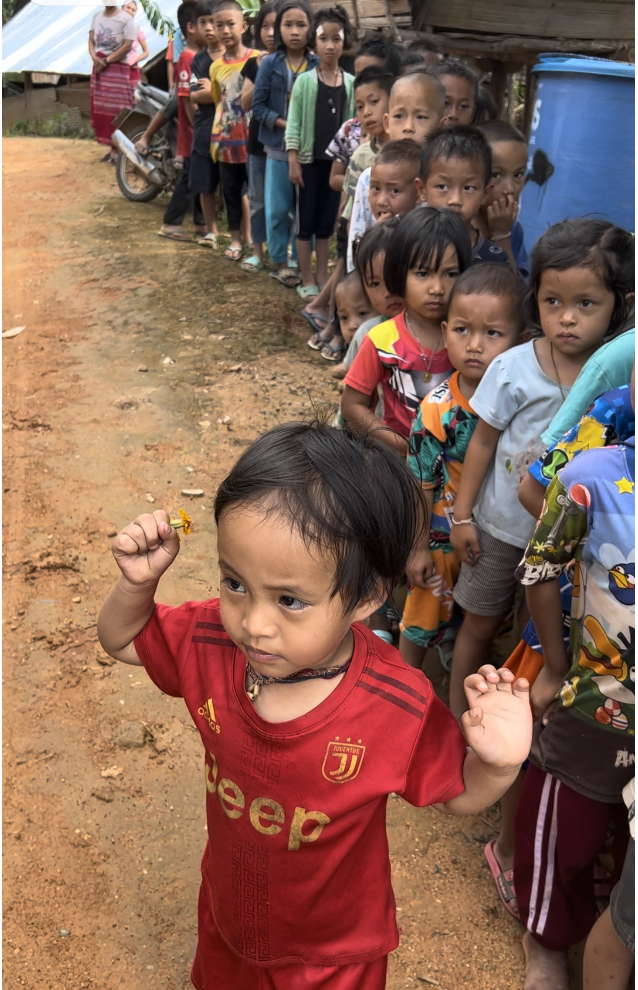
One request that reached our foundation came from a remote health center in Uganda. It was delivering babies at night by kerosene lamp because it had no reliable power. It was an urgent need without a headline. A solar system there can protect mothers and newborns for years.
That’s the kind of help the people left behind need most: the clinic that has to reopen, the water system that has to be rebuilt, the nurse who needs a paycheck so she can afford to stay.
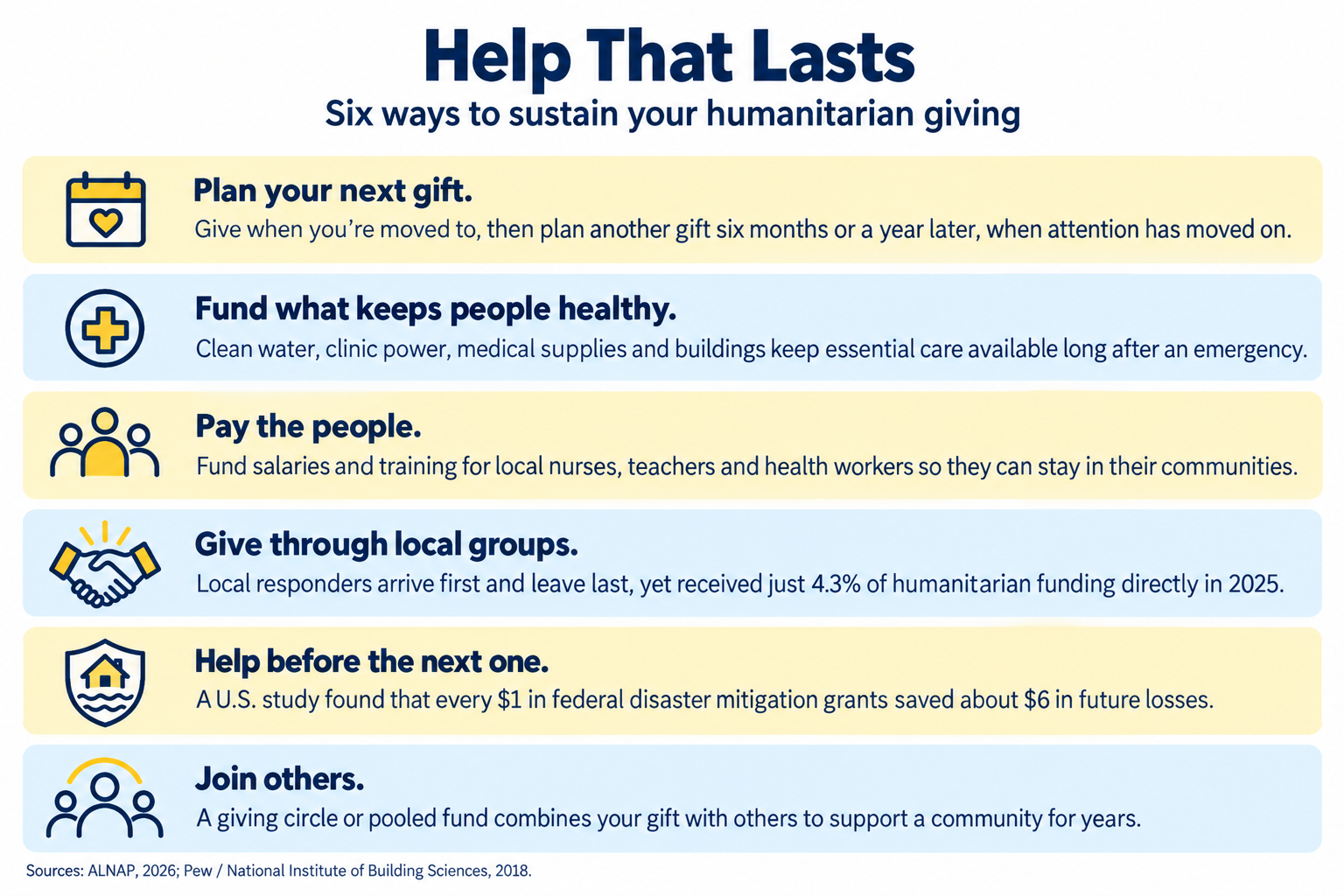
If you want your humanitarian giving to last beyond the crisis, here are a few ways to stretch it:
Back to my client
So, is my client a humanitarian? Yes. Year after year, she makes sure talented students from poor families can stay in school, whether or not their needs ever draw attention. That steady commitment is the kind of planned, lasting help people need most.
I believe that kind of faithfulness is what humanitarian work looks like most of the time: showing up, again and again, for people who are counting on you.
Sources
- Most Americans have donated to those in need within the past year, AP-NORC Center for Public Affairs Research, poll conducted March 20-24, 2025 (topline).
- The Home Depot Foundation commits up to $2 million for Hurricane Helene relief, The Home Depot, 2024.
- Team Rubicon mobilizes volunteers in Hill Country flood response, Texas Standard, July 2025.
- The State of the Humanitarian System 2026: In brief, ALNAP.
- Every $1 invested in disaster mitigation saves $6, Pew.
- Household Food Security in the United States in 2024, USDA Economic Research Service.
- Poverty in the United States: 2024, U.S. Census Bureau.
- To increase charitable donations, appeal to the heart, not the head, Stanford Graduate School of Business, 2007.
- Giving USA: Charitable giving rose to $617.20 billion in 2025, Giving USA, June 2026.