

September 30, 2026
Your Local Bank Could Be Your Next Funding Partner
Understanding the Community Reinvestment Act and what it means for nonprofits
When nonprofit leaders think about fundraising, they usually start with foundations, individual donors, and government grants. Corporate giving often comes next, through sponsorships or employee matching programs.
But there is another potential partner worth considering: your local bank.
In 1977, Congress passed the Community Reinvestment Act (CRA) to encourage banks to help meet the credit needs of the communities where they operate, including low- and moderate-income neighborhoods.
Nearly 50 years later, the law continues to create opportunities for nonprofits working in affordable housing, financial education, workforce development, and economic mobility.
What makes the CRA interesting is that a bank’s interest in supporting your organization may extend beyond charitable giving. Community reinvestment is part of how banks are evaluated by federal regulators.
Understanding that relationship can change how you approach a potential partner.
Why would a bank fund your nonprofit?
Banks have responsibilities that go beyond providing financial services.
Under the CRA, federal regulators evaluate how well banks help meet community credit needs, consistent with safe and sound banking practices. Depending on the institution, evaluations consider lending, investments, and community development services.
Banks receive public performance ratings, and regulators consider their CRA records when reviewing certain applications, including mergers and acquisitions.
This creates an incentive for banks to understand and respond to the economic needs of their communities.
For nonprofits, the opportunity lies in identifying where their programs help address those needs.
Consider a nonprofit serving immigrant families who are new to the United States.
Families may have professional experience and financial knowledge from their home countries but little familiarity with the American banking system. They may need help establishing credit, opening accounts, understanding loans, or recognizing predatory lending practices.
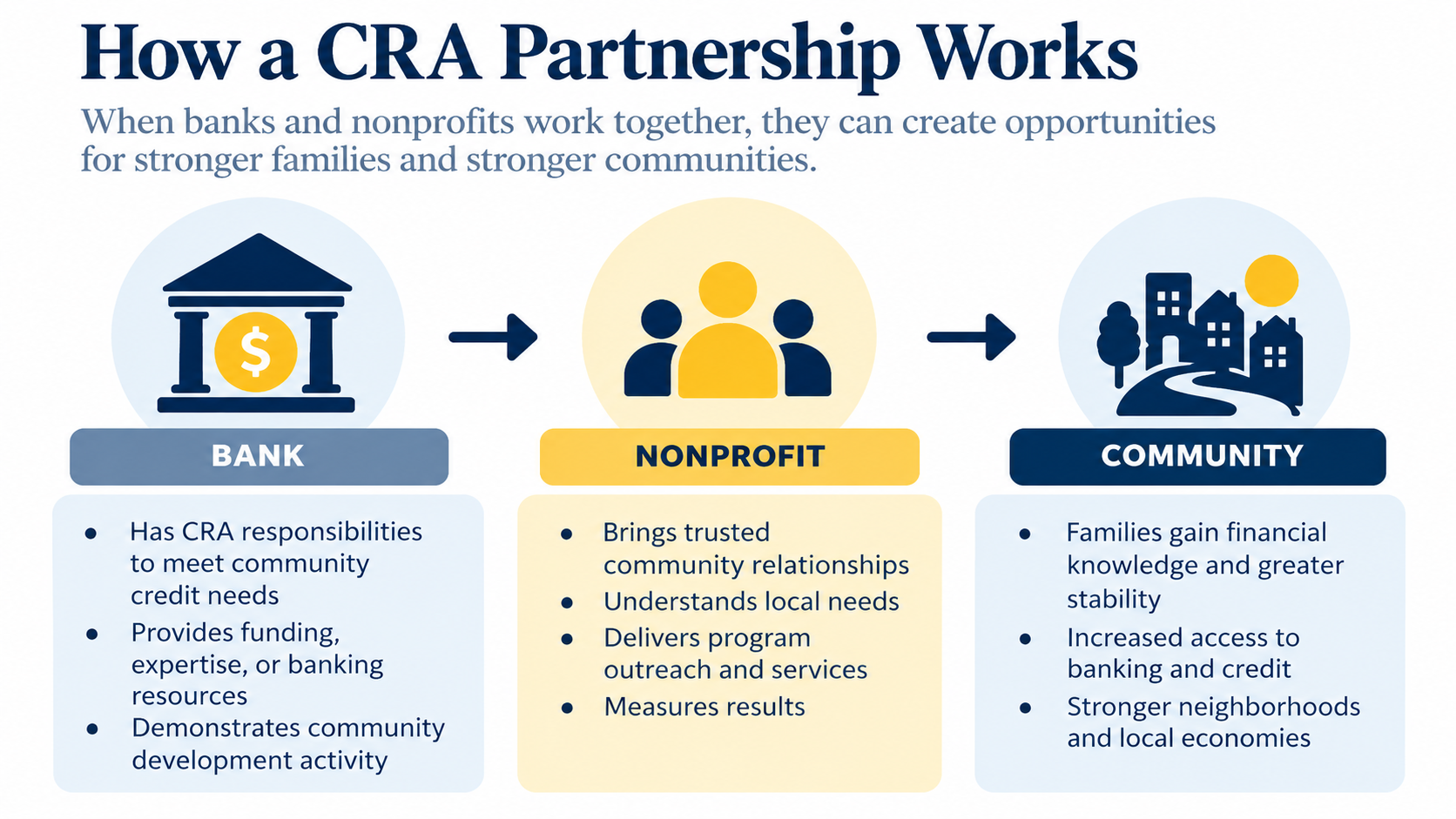
The nonprofit has trusted community relationships and understands the families’ needs. A local bank has financial expertise, trained employees, and banking resources.
Together, they could create a multilingual financial education program.
The bank might provide funding, financial educators, or practical resources. The nonprofit would manage outreach and program delivery.
Families gain financial knowledge. The nonprofit gains a partner. And the bank may be able to demonstrate qualifying community development activity.
That’s a different conversation from asking a bank to sponsor your annual gala.
What kinds of programs might qualify?
CRA-related opportunities extend beyond affordable housing, although housing remains an important area of bank investment.
Depending on the circumstances, qualifying activities may include:
- Financial education: Credit counseling, homebuyer education, and banking literacy for low- and moderate-income households.
- Workforce development: Training and employment services that meet community development requirements.
- Small-business support: Qualifying loans, entrepreneurship training, and technical assistance.
- Community services: Eligible childcare, healthcare, and other services targeted to lower-income residents.
- Neighborhood revitalization: Qualifying investments that strengthen designated underserved or distressed communities.
The important distinction is that not every charitable contribution qualifies under the CRA.
A general donation to a nonprofit may not count. A program with a clear community development purpose, serving an eligible population or location, may be a stronger fit.
The bank ultimately determines how an activity fits its CRA responsibilities.

Start with the bank’s community
One of the most useful features of the CRA is that bank performance information is public.
You can research where a bank operates, how it has performed, and the community development activities described in its evaluations.
Start by identifying three banks with branches or a meaningful presence in the neighborhoods you serve.
Then review their CRA Performance Evaluations through the Federal Reserve, FDIC, or Office of the Comptroller of the Currency.
Look for patterns. Does the bank already support affordable housing? Has it invested in financial education or small-business development? Does it work with organizations similar to yours?
Geography matters because banks are generally evaluated in designated assessment areas associated with their operations.
Once you understand the bank’s priorities, reach out to its CRA officer or community development team.
You are no longer making a cold fundraising request. You are beginning a conversation about a community need that may matter to both organizations.
Build a proposal around results
Imagine your nonprofit wants to help 150 families improve their financial stability.
You could simply ask a bank for $40,000.
Or you could explain how that investment would support multilingual workshops, individual financial coaching, and assistance understanding credit and savings.
Your proposal might establish three goals:
- 150 families participate in financial education.
- 100 participants complete individual financial plans.
- 75 participants establish savings goals or take steps toward appropriate banking relationships.
These are illustrative targets, not guaranteed results or automatic CRA qualifications.
Include the neighborhoods served, the characteristics of the participating households, and a realistic program budget.
Now the bank has something concrete to evaluate.
And don’t overlook nonfinancial support. Bank employees may contribute valuable expertise in budgeting, credit, financial planning, and entrepreneurship. Certain qualifying services can also receive CRA consideration.
What should your board do?
At your next development or finance committee meeting, ask three questions.
Which banks have a meaningful presence in our community? Identify potential partners and review their CRA activities.
Which of our existing programs address economic opportunity? Look for work that already aligns with community development objectives rather than inventing a program simply to attract funding.
What could a partnership accomplish? Consider financial contributions, employee expertise, educational programming, and longer-term collaboration.
Then request a meeting.
Ask the bank what community needs it has identified, where it is looking to expand partnerships, and what information it needs to evaluate a potential CRA-related initiative.
Remember that the CRA does not guarantee funding, and banks are not required to award grants to individual nonprofits. Regulatory requirements also evolve, so confirm current eligibility expectations directly with the institution.
A partnership worth exploring
Nonprofits and banks often serve the same communities but approach their needs from different directions.
A nonprofit understands the barriers families face. A bank may have the financial expertise and resources to help address some of those challenges.
The CRA provides a framework for bringing those interests together.
For nonprofit leaders, the next step is simple: identify the banks serving your community, understand their reinvestment priorities, and consider where your organization’s work creates shared value.
Sometimes your next funding relationship isn’t with a distant foundation.
It may begin with a conversation at the bank down the street.
Sources
- Federal Reserve — Community Reinvestment Act Resources
- Federal Reserve — CRA Performance Evaluations
- FDIC — CRA Performance Evaluations
- OCC — Community Reinvestment Act