

March 6, 2026
Two Ways to Help Your Grantees Win Corporate Partners
A philanthropist I advise asked me a question I hear often: “My grantees depend on me. How do I help them find other funders, especially companies?”
There are two answers. The first is a matching grant, which is financial and transactional. The second is reinforcing the mission with your own team’s skills and focus, and lending your grantees your network. Neither is hands-off. Both take time and attention, and they work best together.
Both ways, in practice
In 2019, at the Rona & Jeffrey Abramson Foundation, one grantee, a high school for more than 1,000 orphaned girls, needed computers. The Eric Schwartz Family Foundation offered a matching grant, and Microsoft and Dell matched it.
Then we reinforced the mission with our own team’s skills and focus. The school’s staff weren’t fluent in English and were uncomfortable applying for grants, so we trained American volunteers to write and submit applications with them. We built the plan around what the girls truly needed, with the care and discipline of a business plan but the heart of a mission. Computers alone weren’t enough: the girls needed expert teachers and software, and the computers didn’t have to be new. So the cash we raised went to teachers’ salaries and software licenses. A new donor to the school encouraged another philanthropist to bring in computer teachers, and education software providers donated programs. The match paid for the machines; the people and the software made them useful.
We later brought in SC Johnson, Nestlé, the Girls Opportunity Alliance and others the same way.
The first way: a matching grant
A match gives the grantee’s development team a reason to call, and it tells a company that someone has already validated the need and the plan. The evidence is strong. In a field experiment with more than 50,000 donors, simply offering a match raised the amount collected per appeal by 19%, and a 2:1 or 3:1 match did no better than 1:1. That study involved individuals, not companies, but the lesson holds: the signal matters more than the size.
Keep the terms simple: a 1:1 ratio, a cap, a deadline that fits corporate budget cycles, and a clear rule on whether in-kind gifts count. And fund the grantee’s time to research, ask and report.

Then implement with fiscal discipline. Track every dollar and in-kind gift against the plan, spend it as promised, and report on time. Nothing builds a company’s trust faster, or makes a second gift more likely, than seeing its support used exactly as intended.
Size the corporate share realistically. Companies typically give about 1% of pretax profits, so a company earning $50 million might give about $500,000 a year across many causes. Companies in Pledge 1% commit equity, profit, product or employee time, and may find it easier to match with software or skilled volunteers than with cash. And starting in 2026, U.S. companies can deduct gifts only above 1% of taxable income, so some may give larger amounts less often. A flexible deadline lets your match meet them in the year they’re ready.
The second way: reinforce the mission
The second way puts your own team’s time, expertise and relationships behind the grantee. Start by helping them understand that companies give for their employees, customers and neighbors, as well as their purpose. Your grantees are not begging. They are offering a company the chance to make a difference for its own customers by addressing a real need.
Find the right door. A company and its foundation may share a name but not a purpose. The foundation wants outcomes and a fit with its focus areas. The business side, though community relations, sales or marketing, wants visibility and goodwill, and may fund a sponsorship the foundation can’t. In smaller companies, those teams are the real filters.
Start with the need. Many companies give by invitation only. List what the grantee needs, then talk to the vendors who supply it. Business association rosters can point to the local sales and marketing people.
Count more than cash. Equipment, services, discounts and coupons all count, especially when the grantee would otherwise buy the item. Earlier in my career, at a wound care company in Canada, we donated bandages and treatments for diabetic foot ulcers to a University of Toronto program serving some of the most vulnerable patients in Haiti. It wasn’t one company acting alone: the whole wound care ecosystem, from manufacturers to clinicians and nurses, engaged. The program trained local nurses and staff to treat their own people. The products made the care possible. The training made it last.
Promote the partnership. Recognition is part of what a company invests in. A partner who sees its role celebrated is more likely to give again.
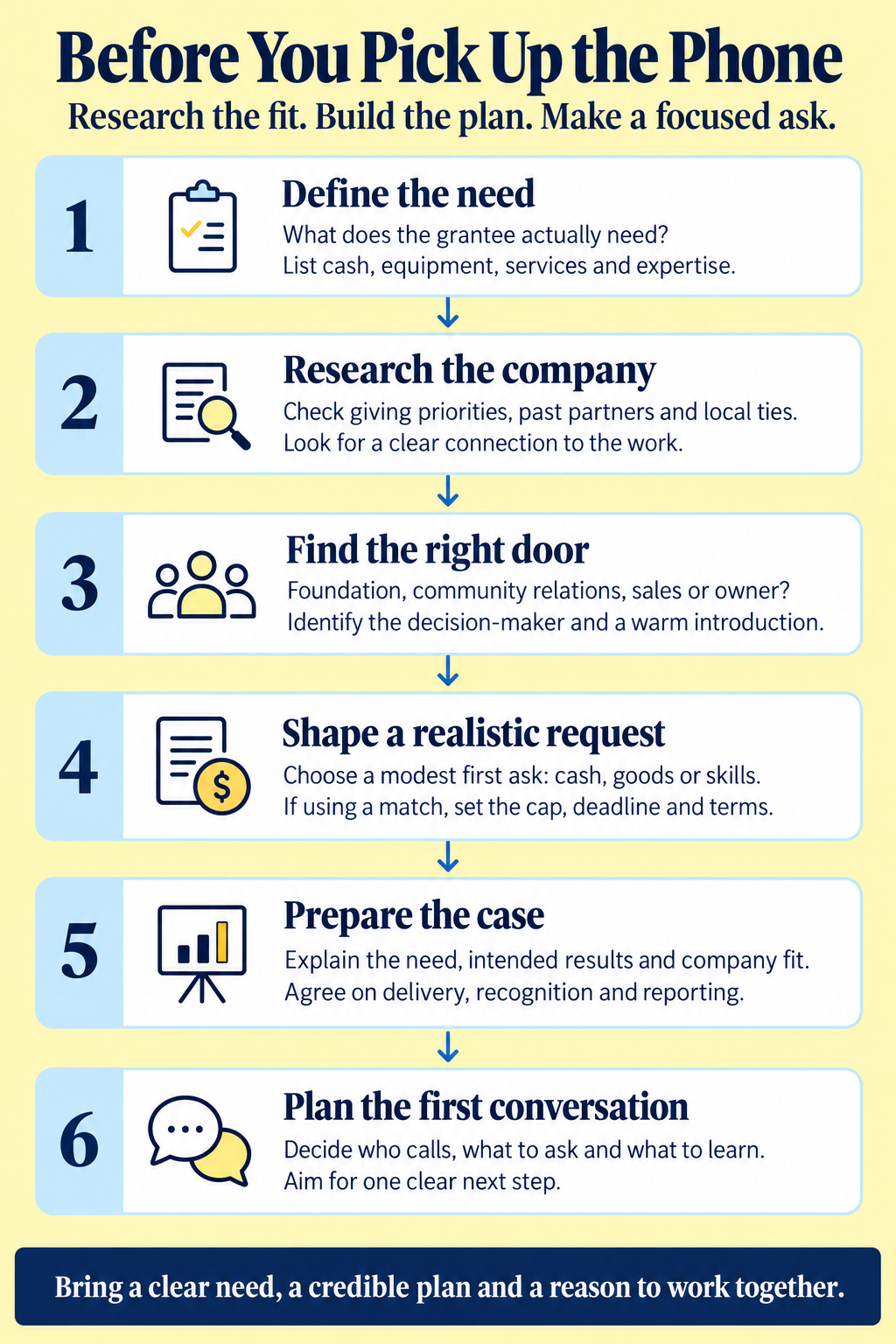
Be creative, and start local: the bank, the realtor, the insurance broker, the gym, the vendors a grantee already pays. Often one owner decides, and the grantee’s community is their community. In larger companies, find the budget closest to the need and the person inside who will champion it.
Two cautions
Don’t ask for too much; a modest first request leaves room to grow. And avoid self-dealing. If you or your own company would benefit, check the rules first. Private foundations face strict IRS limits on transactions that benefit insiders.
The match is the beginning
The best matches leave a grantee with a corporate partner who understands the work, a team that knows how to ask, and a funding base that no longer rests on one donor.
Sources
-
- Effect of matching ratios on charitable giving in the United States, J-PAL, summarizing Karlan and List, “Does Price Matter in Charitable Giving?”, American Economic Review, 2007.
- In the season of giving, corporations aren’t particularly charitable, Stacker, December 2024.
- How it works, Pledge 1%.
- The tax bill will upend corporate giving. Here’s how to prepare, Chronicle of Philanthropy, July 2025.